
On 1 August 2026, I opened Codex with a question that did not sound like a software brief:
Could we build a commercial AI channel, run it through official APIs and eventually monetize it?
I expected an answer. Instead, the question exposed a project.
Across roughly five hours and more than a hundred conversational and working turns, the discussion moved from platform rules to positioning, brand assets, account setup, OAuth, security, deployment, scheduling and an article system.
By the end, @whitebalance_ai had a working identity, a live internal publisher, connected Instagram and X accounts, a scheduler and the foundation for the page you are reading now.
That list sounds like the usual AI miracle story. It was not.
There was no master prompt. Codex did not autonomously disappear for five hours and return with a finished business. The useful part was the loop between a person making decisions and an agent turning those decisions into something we could inspect.
You do not need a 10,000-line prompt to start a project like this. One clear sentence is enough. The project becomes specific while you work: review the first result, add the next constraint, make a decision, test what changed and continue from there.
The dangerous expectation is the opposite — that one “magic prompt” should produce a finished product after a few unattended hours. That was not our workflow, and it is not the lesson I took from it.
The first message was not the brief
The opening question contained an outcome, but almost none of the decisions required to reach it.
What should the channel be called? Should it speak as a company or a person? Which platforms actually matter? Would Instagram require a Facebook page? Where should tokens live? What counts as approval? Should an automated system ever be allowed to publish an article on its own?
Each answer changed the shape of the work.
I did not want Facebook to become another public content channel. I wanted official APIs rather than browser automation. The publisher had to run on existing hosting, without adding a Node.js toolchain. Platform tokens could not live in the repository. Social posts needed an explicit approval step. Articles could be uploaded as drafts, but only I should be able to publish them in the web interface.
Those constraints did more to define the product than the original prompt did.
The prompts that moved the project
The prompts that mattered most were short because they reacted to something real.
I don't want Facebook.
That removed an unwanted public channel and forced the architecture to follow the actual product decision.
Is this backend actually safe?
That turned a working demo into a threat-model discussion about public endpoints, approval boundaries and token access.
This feels like design bloat.
That removed decorative UI which was technically polished but added no information.
Commit after changes. I have parallel tasks.
That changed how work was packaged so another task could continue without inheriting a pile of unrelated edits.
None of these prompts tried to describe the entire finished system. Each one made the next version more correct.
The task kept changing shape
The project did not progress in a straight line from idea to code. It moved through a series of smaller problems, each with a different kind of evidence.
Research required current primary sources. Brand decisions required taste. OAuth required manual account access and live callbacks. Deployment required a server that behaved differently from the local environment. Security required us to ask what an attacker could do, not merely whether the happy path worked.
Codex was most useful when it could move with that changing shape without pretending the earlier plan was still complete.
It researched the official platform paths, translated decisions into repository rules, implemented a small PHP publisher, wrote tests, deployed files, inspected failures and documented durable knowledge for later tasks. When a result was visible, I reacted to the result rather than trying to predict every detail in advance.
That distinction matters. I was not delegating one giant outcome. I was creating a sequence of verifiable ones.
What Codex handled
The agent was good at work that benefited from continuity and repetition:
- tracing requirements across code, configuration and documentation
- implementing constrained backend flows and their tests
- checking that secrets stayed outside the repository and public document root
- diagnosing API and OAuth failures from concrete responses
- keeping architecture decisions and open questions in project memory
- repeating deployment and smoke-test steps consistently
The accumulation was the real advantage. A decision about approval could become a database state, an interface rule, a test and a line in the project documentation. It did not have to remain a sentence buried in an old chat.
For example, the human rule “the API may prepare a draft, but it may never publish” eventually became a literal code boundary:
if ($current['status'] !== 'draft') {
    throw new RuntimeException(
        'Published articles cannot be changed through draft ingest.'
    );
}
That is the kind of code worth sharing: not because it is complicated, but because it shows a decision becoming enforceable.
What remained human
The agent could explain options and implement a choice. It could not decide what I actually wanted the project to become.
I created and accessed the accounts, enabled two-factor authentication, worked through developer portals and confirmed OAuth screens. I chose the public name and tone. I rejected directions that felt wrong. I decided how much automation was acceptable and kept final publishing under human control.
Taste was especially difficult to delegate.
An early article design technically worked, but it felt overdesigned. The problem was not a broken component that a test could detect. It was the sense that decorative elements were performing “AI product” instead of supporting the writing. A screenshot and a direct reaction — this feels like design bloat — were more useful than another elaborate design prompt.
Before, after, after after — then deleted
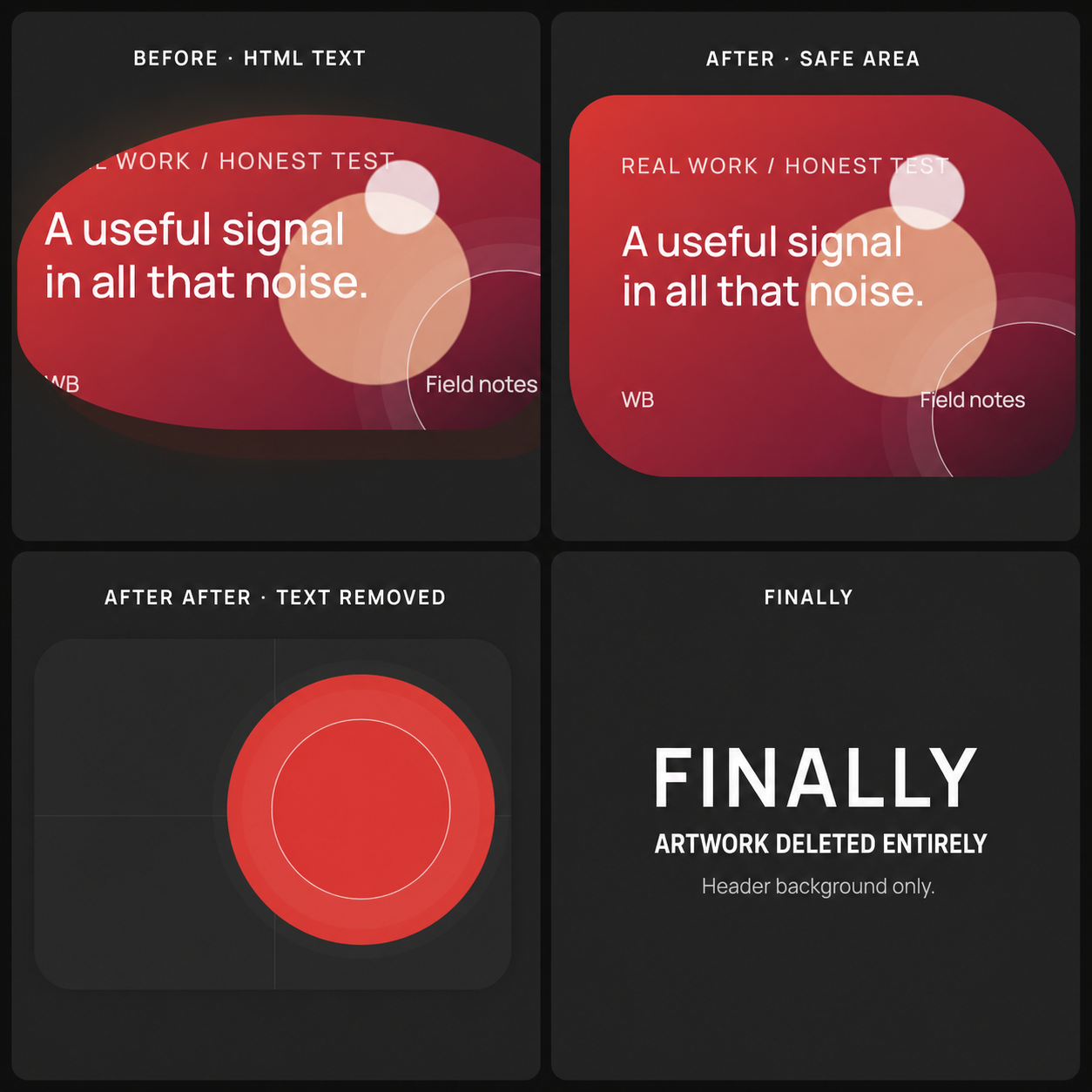
Before: The artwork contained selectable HTML text. Its organic crop cut into the label and footer.
After: More padding and a safer shape fixed the clipping, but the white filler copy still competed with the graphic and said very little.
After after: We removed every fake headline and label. What remained was a technically tidy red calibration target — and almost no reason for it to exist.
Finally: We deleted the decorative artwork entirely and let the title, typography, spacing and actual evidence carry the article.
That absence was the final design decision. The interface improved because each round of feedback described the visible problem, not because the first request was perfect.
The mistakes were part of the build
One of the most useful moments was a failed Instagram token exchange.
The OAuth callback reached the publisher, but the long-lived token step used the wrong HTTP method. This was not solved by confidently generating more code. It was solved by following the failure to the exact request, checking the current platform reference, correcting the method and running the flow again.
Another deployment route initially exposed more of the hosting subscription than it should have. We did not accept that because the connection was encrypted and technically functional. We created a narrower deployment account and tested the boundary again.
Later, when we added a signed article-draft API, the first question was not “does the upload work?” It was “did we accidentally create a path to publish on Instagram or X, or to reach their tokens?” The review found no such path, but it also produced four hardening tasks. Passing the main test did not end the security conversation.
These corrections are not footnotes to the project. They are where much of the useful work happened.
The project learned while we worked
Long AI conversations usually have a memory problem. Important decisions become difficult to distinguish from temporary ideas, and a new task starts by reconstructing old context.
We changed that during the build.
Durable rules moved into the repository. A knowledge index pointed to the current architecture, platform status, content strategy and open questions. Important decisions received short records explaining not just what we chose, but what we rejected and why. Session histories captured outcomes without storing complete conversations or secrets.
That project memory changed the collaboration. A later task did not need the entire five-hour transcript. It needed the current rules, the relevant decisions and the actual files.
The best context was not more chat. It was a better project.
What I would do again
I would not begin the next project by searching for a more impressive prompt. I would begin with a real outcome and make the working loop explicit.
A useful starter can still be very small:
I want to [build a real outcome].
Start with [the first uncertainty or deliverable].
Constraints: [what must stay true].
Show me the first result I can review.
Then continue from the evidence instead of trying to predict the whole project in advance.
- Give one task a coherent result that can be inspected.
- Put durable constraints where the agent will encounter them during the work.
- Make risky capabilities narrower than convenient capabilities.
- React to screenshots, test output and live behavior with direct language.
- Preserve decisions and open questions, not entire conversations.
- Keep consequential approvals human unless there is a very good reason not to.
The result: what one sentence became
The opening sentence did not generate a finished project. It opened a working loop. At the end of that loop, we had:
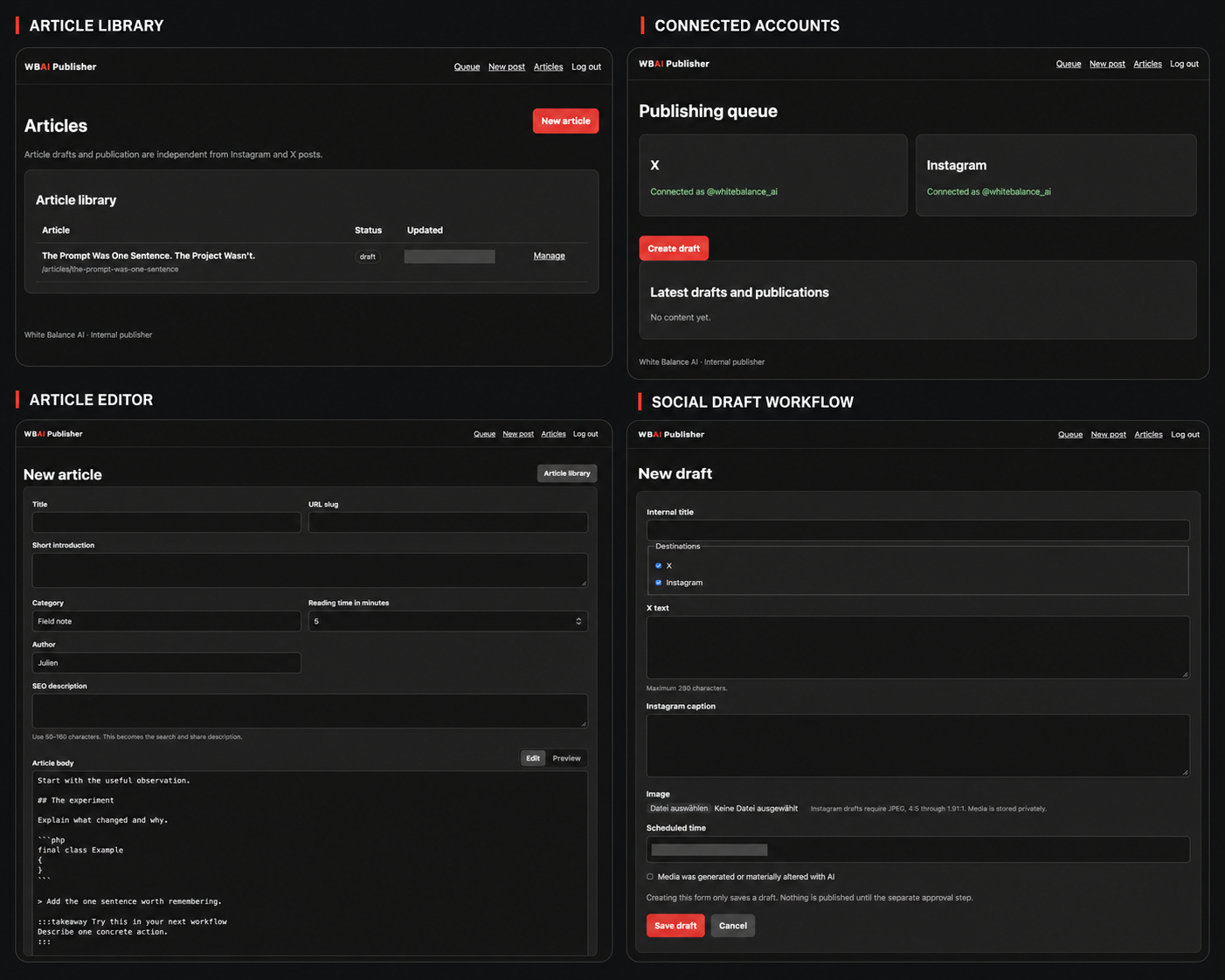
- a defined English-language AI channel with its own positioning and visual direction
- launch content and a three-part editorial structure for Our AI Journey, AI Tips and AI News
- an internal PHP publisher running on our existing hosting
- official OAuth connections for the intended Instagram and X accounts
- encrypted token storage, version-bound approvals and a server-side scheduler
- a public article library with a private editorial workflow
- a signed upload path that may create an article draft but cannot publish it
- tests, a security review and persistent project knowledge for the next Codex task
We did not yet have a successful public social-post test through the system. That remained an explicitly unfinished step, not something to smooth over for a better story.
The result was real, but so were its boundaries.
One sentence was enough to start. It was never enough to finish.
The project emerged from everything that followed: the questions, the refusals, the account screens, the failed callback, the design criticism, the tests and the final human decisions.